Sunday, 13 October 2013

Welcome to the Mediterranean - Croatia

10 - 17 August

I arrived in Croatia's capital, Zagreb, after a 6-hour train from Budapest. The quality & frequency of the train systems in Europe's eastern countries is definitely worse, but they still run and there's one big benefit - they're a lot cheaper that German, Dutch or French trains.

Lindsay & Hannah (who I'd met in Budapest) were staying at the same hostel, having arrived the day before, and Lindsay came and met me at the train station to catch the tram, a welcome gesture after the long train ride. From Zagreb, they decided to travel seperately for the rest of their trip, and Lindsay & I ended up travelling together for 3 weeks from Zagreb through Croatia, Slovenia & Italy.

Zagreb is a small city, so we spent just one day looking around at it's sights. The country has only recently become part of the EU, but still has it's own border controls - the only ones I encountered in four months in Europe (I can't imagine what it would have been like previously with passport checks at every border!).

Croatia seems proud to now be part of the EU
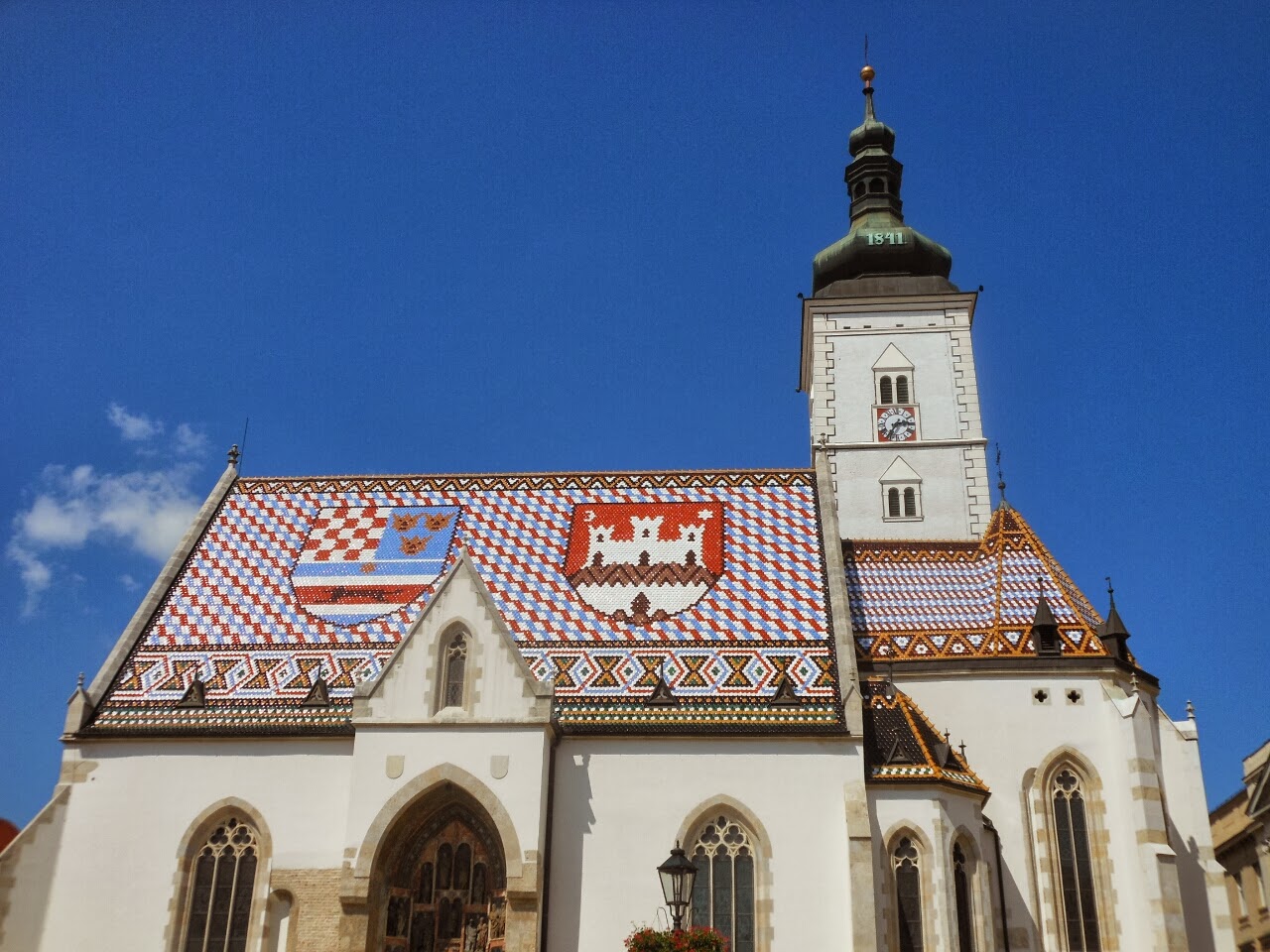
The very colourfully-tiled Crkva sv. Marka (St Mark's Church)
Zagreb was really only intended as a stopover on the way to the coast, and so the next day, we took a train (another 6 hours!) to the city of Split, a coastal resort town in Croatia's south. I'd been hoping to get to Dubrovnik, which is even further south and where scenes from Game of Thrones have been shot on the city walls, but Split was a more-than-satisfactory destination in its own right...

The Split seafront
Heading down to the beach seemed to be a popular thing to do... I can't imagine why, the water was so clear and the weather so warm...

One of the beaches in Split - zumba classes at the water's edge, and crowded with people well into the evening
Dusk looking out to sea from the Split waterfront
The city of Split itself is actually very old, with the remains of a Roman palace built in 305 AD forming the core of the city (in fact Greek remains have been found there from much earlier).

Diocletian Palace (from Roman times) forming the central, car-less "old city" of Split
Croatia is famous for it's islands - scattered along the coast are over 1,000 of them, the exact number depending on how an island is defined. Several of the largest are around Split, so we headed for the town of Stari Grad on island Hvar for a day trip. The island was lovely - I felt like I could stay there for a week, drinking in the sun (and a few beers!), and the water was crystal clear and gorgeously warm...

View back towards Split from the ferry
Not a bad spot for a picnic lunch...
The small town of Stari Grad, Hvar
As relaxing as Split was, Lindsay and I both wanted to get off towards Slovenia & Italy, so we headed back north, choosing to stop for a day at the Plitvice National Park. We were very glad we did - despite being quite full of tourists, the day spent walking around this stunning landscape was well worth it. The park, in mountainous karst landscape, was one of the first natural sites to be listed by UNESCO - and you can see why...

One of the largest lakes - the park is centred around a magnificent series of cascading lakes down through the narrow valley, all in rich blue and green colours
Veliki Slap, which literally translates with "Big Waterfall"
The waters are not only gorgeous turquoise colours, they are also perfectly clear
Lindsay & I & the view
Late that day we arrived back in Zagreb for the night again, spent the last of our Croatian Kunas & enjoyed a couple of Croatian beers, and then reluctantly were on the train again the next morning, bound for Ljubljana, Slovenia.

Had we thought Croatia was beautiful? Definitely. Was the more - and better - to come? Unbelievably, yes...

Saturday, 12 October 2013

Pest & Buda

06 - 10 August

I arrived in Budapest (pronounced Budapesht), Hungary's capital and a city with a rich and colourful history, whose name is derived from the combining of the cities on either side of the Danube River - Buda (west side) & Pest (east side). This fascinating city has ties to the Austro-Hungarian empire, but also many communist influences in the post-war period, and I found it to have a wonderful character that wasn't present in some of the more famous European capitals, such as Vienna, Berlin or Rome - and there were less tourists around too!

I stayed in a refreshingly small and friendly hostel that accommodated just 13 people and had a neat atmosphere and lots of Euro backpackers like-minded to me - not the stereotypical drink-alcohol-and-sleep-and-take-photos variety. Somehow I ended up spending most of my time with Canadians, with three different groups staying there.

My first morning there, I headed up to Várhegy (Castle Hill), the oldest part of the city and with an excellent view over the river towards the Pest side:

Statues of the Magyar horsemen & Hungarian flag
Mátyás templom (Mathais Church)
View from Várhegy over the Danube to Pest & the third-largest parliament building in the world
More of the view
A large inner-city square made a good spot for evening beers - liquor licensing laws are definitely more relaxed than in NZ! - which I enjoyed with Lindsay and Hannah, two Canadian girls from the hostel.

The next morning, Lindsay, Hannah & I joined Jan & Martha - two more Canadians - for a free walking tours, which are generally very excellent - often they are run by local students working during the summer, and they give a good overview of a city for the price of a few tips.

Jan, Martha, myself & Hannah trailing the tour guide around Budapest
Guards sweltering in the heat - apparently for show only - outside the president's offices on Castle Hill
The tongue-less lions of the Chain Bridge between Castle Hill and central Pest over the Danube River
The European summer heat wave was hitting it's high point, and one day the mercury even topped 40°C. It made going outside pretty hot, but one popular "attraction" in the square outside the Szent István Bazilika (St Stephen's Basilica, named after the first Hungarian king) was the water sprayers...

Martha & Hannah cooling off in the water sprayers... Who seemed to be there just to cool people down, and not actually doing any work!
I think what I liked about Budapest was not necessarily anything specific about the city, but more the character and atmosphere in and around the city. No doubt that was related to the people I met at the hostel too, but I thought it was a lot more interesting and colourful than Vienna.

Budapest also has hints of the architecture of more famous cities - some advice I got was not to forget to look up, where you could see more of the detailed decorations on the buildings. Hungary's capital also hosts one of the largest parliament buildings in the world, which, at 96 m, is exactly the same height as St Stephan's Basilica - except during the communist era, when a red star on top made the parliament building taller than the church.

After meeting three more Canadian guys travelling together and the 7 Canadians and I enjoying some drinks in the hostel, we headed out to an excellent example of Budapest's more interesting character - Szimpla, one of the famous "ruin pubs". Basically these inhabit old communist apartment blocks that fell into ruin, until someone came up with the bright idea to put a funky, off-beat pub in the inner courtyard. Filled with all sorts of slightly-hippy decorations, it served as a great place to spend a few forints and a night talking. Lindsay and I ended up there until almost closing time, after 3am.

The next morning I headed off by myself to the city park, Városliget. This large park is home to one of the largest Turkish baths - more about them later - as well as the Hősök tere (Heroes' Square), which hosts the monument celebrating the countries' millennium existence, and the Vajdahunyad Vára castle.


Heroes' Square
One of the heroes of the founding of Hungary
The fairytale-like Vajdahunyad Vára castle
Vajdahunyad Vára castle again
Lindsay and Hannah had left for Croatia that morning, but that night, the remaining Canadians and I headed off to one of the Turkish baths of the city. The city was occupied by Turks for a long period of its history, and the city is covered in public bathing houses, many of which are single-sex and togs-optional at various times (we went during a unisex, togs-required time!). The process of moving between hot pools, cold pools, hotter pools and the steam room etc was quite fun and all very relaxing and no doubt good for the muscles!

So, after 4 days enjoying a city I had no real expectations for, I was a bit sad to be heading off again. However, the call of the Croatian coastline and the Mediterranean was getting pretty strong, so the next day it was back on the trains and off to Zagreb...

Thursday, 10 October 2013

The centre of an empire - Vienna

02 - 06 August

The overnight train from Kraków was better than expected - I was jolted awake several times during the night but managed to get a reasonable sleep and arrived in Wien (German for Vienna) at the early time of 6:20 am. After dropping my bags and finding breakfast, I had a good opportunity to explore the city centre. For a €1 admin fee, I rode around on the excellent city bike system during my stay - better than the metro.

As I followed a suggested walking route around the city, the fact that it had been the centre of the powerful Austro-Hungarian empire was immediately noticeable - there were many lavish, impressive buildings exhibiting some stunning architecture in the city centre. I started at the Stephansdom - St Stephen's Cathedral.

Stephansdom with Austrian roof tiling and the fire-damaged bell tower
Stephansdom interior
Walking down one of the most expensive streets in Europe - a string of high-end fashion and boutique stores - I made it to St Peters church, a small church with some Michaelangelo-like dome frescoes - and the square around it was Petersplatz. It's kinda cool seeing placenames with your name on them!

Petersplatz!
From there, my suggested route took me past the oldest church in Wien - built in 740. Seeing that gave quite a perspective on the amount of history in the city, how long it had been there for - the oldest building in New Zealand (in Kerikeri) was completed in 1822.

Passing the unimpressive Danube Canal I got to the Votivkirche, which displayed some more stunning architecture. Although the continuous stream of churches can get a bit tiresome, this one was interesting in that it was built to thank God for saving the life of the emperor Franz Joseph from an attempted assassination attempt in 1853.

At Rathausplatz (Rathaus = City Hall), the square and gardens were hosting a free open-air film festival. The hall itself was another masterpiece of architecture, though the massive screen ruined the view somewhat. A number of speciality food outlets had been set up, as well as a bar serving some craft beers, so I got a refreshing Radler to try and get some relief from the midday heat of the sun. For the afternoon, it was stunning architecture left, right and centre...

Rathausplatz set up for the open-air film festival
Rossauer Kaserne
Parliament Buildings
Michaelerplatz - where some 20-odd horse drawn carriages were waiting to take wealthier tourists on a pompous trip around town
To be honest, I saw so many architecutral wonders, I can't actually work out where this is. I think it's the Hofburg Wien...
Wien has, of course, a long history of musical culture - during the 1700s & 1800s, the city played host to many of the best composers of classical music. The tourist hotspots are amusingly surrounded by touts dressed up in baroque costumes, complete with wigs and long socks, trying to sell tickets to classical music concerts. Given I was in Wien, I did fork out the somewhat inflated ticket price to see a string quartet play a selection of pieces performed inside the Stephansdom. Hearing top quality classical music in one of Europe's largest churches with excellent acoustics was a neat experience.

The next morning I headed off to Wien's southern suburbs for quite a different tourist attraction - the Zentralfriedhof. This massive city cemetery is host to the graves of some of the best minds in classical music and Austrian history. A specific section dedicated to musicians included Beethoven, Brahms, Schubert and several of the Strauß family as well as a monument to Mozart, but not his actual grave. Many Austrian presidents are buried there, as well as the likes of physicist Ludwig Boltzmann (famous for theory on kietics of gases and the Boltzmann constant) and pop/rock singer Falco.

Ludwig van Beethoven's well-adorned grave
A monument to Wolfgang Amadeus Mozart in the city centre
After several hours walking around the cemetery, back at the hostel I caught up on some of those things that are sometimes hard to find time to do - organising the next stages of travel, booking trains or hostels, writing my journal, replying to emails, doing washing, packing and unpacking my stuff. It's amazing how much time this can often consume - depressingly so - especially when on the road for almost a year. While there are many highlights to travel, there are also the boring old realities as well!

In the evening I went to a free organ concert at the St Peters church I'd visited the day before - where the acoustics were even better than the Stephansdom. On the Sunday, a jazz band was scheduled to be playing in the Rathausplatz, so in the scorching summer weather I headed back there and spent several hours listening to some real old school jazz. I was younger than the average age of the crowd by about 40 years - some elderly locals were really enjoying it, and I have to admit I was too - jazz, sun, beer - what could go wrong?

The Orignal Storyville Jazzband playing in Rathausplatz
The afternoon, and on my last day, I headed to several empire palaces, the Belvedere and Schönbrunn. The Schönbrunn in particular had a huge palace and grounds - which now also incorporate the city zoo - where there were many statues, immaculate gardens, a dominating palace, and a hill within the ground allowing an excellent view over the whole complex.

Belvedere Schloß against the backdrop of gathering clouds (What's this? Rain?)
Schönbrunn Schloß & gardens (no, no problem, sunny & 30°C again)
Schönbrunn Hill
View of Schönbrunn Schloß from Schönbrunn Hill
Back at the hostel, I was discussing how to get to Budapest with the receptionist at the hostel, who managed to organise me to meet some Hungarian at a metro station to buy the second half of a return ticket - the Hungarian railways sell cheap return tickets (cheaper than one-way!) from Budapest that have to be used within four days, so many people on-sell them. I was a bit sceptical whether I'd been duped, but at €12 instead of about €30 for an Austrian ticket, I gave it a go. I was nervous when the inspectors came on the train the next morning, but everything was fine. The Austrian RailJet was the nicest train I've been on to date - pity there weren't any seats - and by lunchtime I was in Hungary, hungry for more adventures (sorry couldn't resist the pun)...

Wednesday, 2 October 2013

Kraków Part 2 - a polar opposite experience

30 July - 01 August

The remainder of my time in Kraków, aside from exploring the Jewish history of the city (see Part 1), was spent with some quite different experiences. Kraków is a very gorgeous city, and in my opinion deserves more attention on the tourist trail than it gets.

The central old city is surrounded by defensive walls, and it's main square is (of course) host to an impressive cathedral and town hall buildings. When I was there, there was also a leg of the Tour de Pologne cycle race starting in the main square.

St Florian's gate in the city walls
Cyclists preparing for a leg of the Tour de Pologne in the Stare Miasto (old town centre). There must have been some fmaous riders, because lots of people were getting photos and signatures.
On another day, on the suggestion of Melody (who I'd met in Katowice), I headed to Nowa Huta. Literally meaning "new steel mill", Nowa Huta was built by the communist regime in 1949 as a satellite town to Kraków, and is  a striking example of what life under the communists would have been like - strictly organised, industrial, and if the buildings were anything to go by, damned dull.

Almost every single building looked exactly like this - boring and grey
The massive steel mill from which the town gets it's name is located on its outskirts. It's so big, the workers take buses inside the mill to get to their jobs. It is still operating, but the original name - Vladimir Lenin Steelworks - was, understandably, replaced with the fall of Communism.
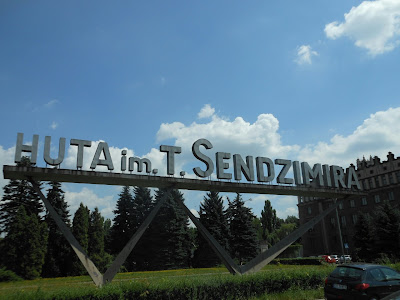
"Huta im. Lenina" is no more
Nowa Huta was host to a large number of demonstrations and street protests - some of which turned very violent - relating to the Solidarity movement in Poland, which led to the fall of communism in the country. A massive statue of Lenin was situated in Nowa Huta's main square, and thousands turned out when it was pulled down in 1989. Nowa Huta also has a fascinating church - which was very controversial when first built during the communist regime.
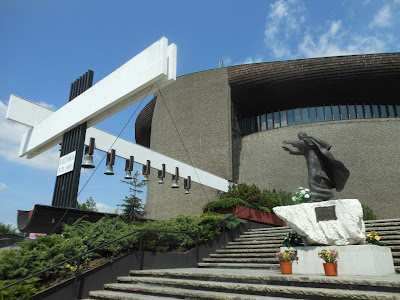
Arka Pana ("Lord's Ark") church with a statue of Pope John Paul II.
The Pope was Polish and a previous Archbishop of Krak
ów, when he was known as Bishop Karol Wojtyla. He consecrated the church in 1977, but he was not permitted to visit it after becoming Pope in 1978.
In Nowa Huta I also discovered some of the unusual small wooden churches typical of southern Poland. Representing medieval architecture, a number of them are even UNESCO world heritage sites (though not this one).
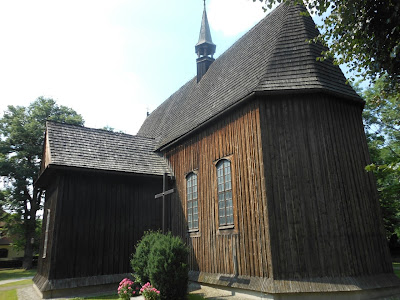
Parafia rzymskokatolicka św. Bartłomieja (Parish of St Bartholomew) - a tiny wooden church typical in southern Poland
During my evenings in Kraków, I got to sample a small taste of Polish nightlife - including a zapiekanki - bugger the McDonald's burger or Subway, this bread is the local fast food favourite! I also found another excellent jazz bar, U Muniaka, with another excellent basement performance, which I enjoyed with 2 Canadians from my hostel.
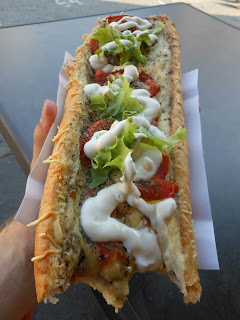
Zapiekanki
My last day in Kraków, I had two more things on my list. The first was a walk to the Kościuszko Mound. Polish people seem to like constructing commemorative mounds - literally just large mounds built on the land - for important people, and I'd previously climbed the Krakus Mound near the Podgórze ghetto. While the Krakus and Wanda mounds were built many hundreds of years ago, this one, built in 1823, commemorates Tadeusz Kościuszko, a Polish hero who led the Polish army against the Russians in the late 1790s. Interestingly, he is also an American war hero, having fought in the American Revolutionary War in the 1770s.

The mound is now surrounded by fortifications built by the Austrians in the 1850s. It was also extensively repaired after severe rains in the 1997, with start of the art drainage systems and waterproofing membranes... All for a mound of dirt! The location, on top of a hill, also gave commanding views over the city...
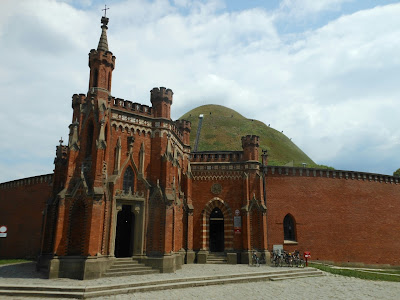
Kopiec Kościuszki (Kościuszko Mound) & its fortifications
Views from Kopiec Kościuszki over Kraków
Back in town, I visited the dominant Kraków Wawel, a large complex including the Royal Wawel Castle and the Wawel Cathedral, perched on a dominant hill overlooking the Vistula River. The Wawel has variously served as the location of royal coronations, the seat of the president, and also the residence of Nazi Governor General Hans Frank during the existence of the Generalgouvernement (of which Kraków was the capital) during World War II. It is now a also a national museum.
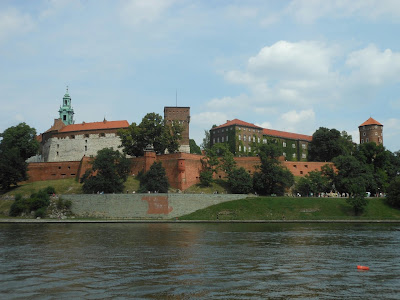
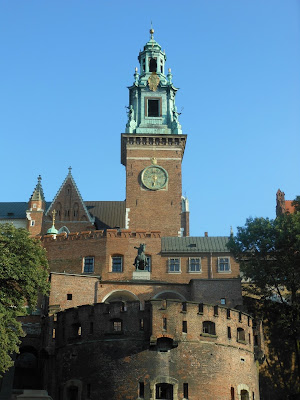
Kraków Wawel by the Vistula River
Kraków Wawel
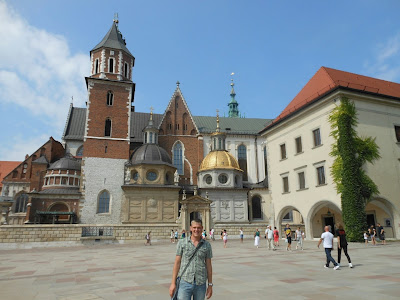
Wawel Cathedral
I had a night train booked to Vienna, in Austria, and so filled in the remainder of the evening journal writing by the river... And was rewarded with a stunning riverside sunset. Then it was off on the night train - something I'd never done, but surely it couldn't be as bad as overnight buses in Peru?

Sunset on the Vistula River - and on my stay in Poland
The surprisingly comfortable and spacious overnight train berth to Vienna
So, once again, just as I'd got used to the place I was visiting, it was time to move on. 6 days in Poland really wasn't enough, and I think it deserves more visitors than it gets. The history is fascinating, and the cities and architecture are every bit as impressive as the "highlight" cities that are more popular. However - onwards to Austria!