Wednesday, 2 October 2013

Kraków Part 1 - Jewish history

28 - 31 July

After a very sombre day of visiting the concentration and extermination camps of Auschwitz, I had a further five days to explore some of the rest of the south of Poland.

I was still in Katowice, which is not a tourist destination for the average traveller. Waking up on the 28th it was suffocatingly hot outside - pushing into the high thirties and melting the pavement asphalt. I stayed inside catching up on some emails and the like, and had lunch with the American girl (Melody) I'd met before, discussing our experiences at Auschwitz - she had a different perspective on it, being Jewish herself. When she left for Wrocław (pronounced something like "Vroswav"), I reluctantly went for an explore in the heat. There wasn't much to see and before long I was back sheltering inside.

The next morning I took a short bus ride (less than €3 for a 1.5 hour trip!) to Kraków, Poland's second biggest city after Warszawa (Warsaw). Kraków is a lovely old heritage city, and in late July was hot and popular with tourists. In the afternoon I took a free (well, tip-based) walking tour of the Kazimierz district, which is the Jewish quarter of the city and steeped in history.


Jewish monument near the Remuh Synagogue
Tempel Synagogue
Kazimierz was originally a separate city, founded by the Polish King Casimir III in the 13th century. Over the years it became a popular location for Jewish residents of Kraków, and was eventually made part of the larger Kraków city. Over 120 synagogues were in Kraków by the 1930s, and the city had some of the richest Jewish culture around.

Interestingly, for many years, the Jewish and Christian parts of Kazimierz were clearly defined as separate, with a wall between the two parts until 1822. Perhaps this was a precursor to the event of World War II - when the invading German army occupied Kraków, the Jewish residents were expelled to the area of Podgórze, south over the river. This became the Podgórze ghetto, and when I walked around there several days later, I found some remnants of the walls that surrounded the ghetto when in use (March 1941 - March 1943). Some 15,000 Jews were squeezed into the small area - 4 Jewish families per apartment. The other 50,000 or so Jews who had previously lived in Kraków had already been resettled out of the city.


The tombstone-like walls of the Podgórze ghetto - beside what is now a children's playground
Plaque on the old ghetto walls
The liquidation of the ghetto between May 1942 and March 1943 resulted in "fit-for-work" Jews being sent to the Plaszow labour camp, the others being sent to Auschwitz - or simply murdered on the streets.

If any of this sounds familiar, then you've probably watched Spielberg's Schindler's List movie, which is (mainly) set in Kraków. If you haven't, I recommend watching it. Although based on a true story, the movie does contain many historical inaccuracies - but it does paint a very vivid picture on the harsh realities of Jewish ghetto & labour camp life during World War II.


A filming site in Kazimierz from the movie Schindler's List (used during the liquidation of the Jewish ghetto).
Although set in Podgórze, the movie was mostly filmed in Kazimierz since the buildings are much better preserved.
The story of Oskar Schindler - a member of the Nazi party - is very two-sided, and an interesting one to investigate. The movie paints him in a very good light, but many stories of his womanising and alcoholic tendencies also exist. He bought a factory in Kraków that initially employed Jews because they were cheaper - but over time he used the factory to help keep Jews out of labour or concentration camps by giving them jobs there, and did save the lives of some 1,100 Jews by transporting them to a new factory in the Czech Republic when they were destined for the gassing chambers.

I also visited an excellent museum at the site of Schindler's actual factory. While not directly related to the story of the factory, the museum displayed the history of Kraków during World War II in a very informative and interesting way.


Plaque commemorating Oskar Schindler at the site of his factory - "Whoever saves one life, saves the world entire"
The last place of interest was Plac Bohaterów Getta (the Ghetto Heroes' Square) in Podgórze. This was where Jews were sent with all their possessions before being herded to the trains when the ghetto was liquidated. They were all told to leave their possessions behind - never to be seen again, of course. A photo of an empty chair in the square, taken after liquidation, inspired a memorial that is now located there - a square full of empty chairs, representing the loss when the Jews were expelled from the city.


Plac Bohaterów Getta
An empty chair representing the emptiness after the Jews were expelled from Kraków
After years of neglect during Communist rule, the Kazimierz district is now undergoing a new lease of life as a hub of activity in Kraków. It's now a popular nightlife and restaurant destination, but it's true Jewish culture will probably never be comparable to what it once was.

Of course, there is a lot more to Kraków than the Jewish history - so, read on to Part 2.

Saturday, 21 September 2013

The concentration camps of Auschwitz

27 July

Note: This post is pretty depressing. Don't read on if you're not prepared for it.


I think this will be the only post I make that only covers one day. I think the subject matter deserves it.

Just over a week earlier, in Berlin, I spent quite a lot of time exploring the darker side of the city's history. Places like the Memorial to the Murdered Jews of Europe, the Topography of Terror Exhibition, the remnants of the Berlin Wall. Visiting Auschwitz was a very moving complement to those experiences, one that I felt I needed to do, and wanted to do, despite knowing that it would not be a particularly enjoyable day.

Leaving early from my hostel in Katowice, I caught a train to the town of Oświęcim. Oświęcim is the name of the Polish village from which the Germans named the largest concentration camp in World War II - Auschwitz is simply a Germanisation of Oświęcim.

The train was a bit difficult to find - it left from a small back platform of the train station and was only one carriage. Most people take buses from Kraków. Unfortunately that also meant the site was hard to find from the train station. I was headed first for the site of the camp known as Auschwitz I, the original camp set up in an early stage of the war. The massive Auschwitz II-Birkenhau site, nearby, was built later and was much larger, including being in the process of enlargement when the camp was abandoned by retreating Nazis.

Auschwitz I

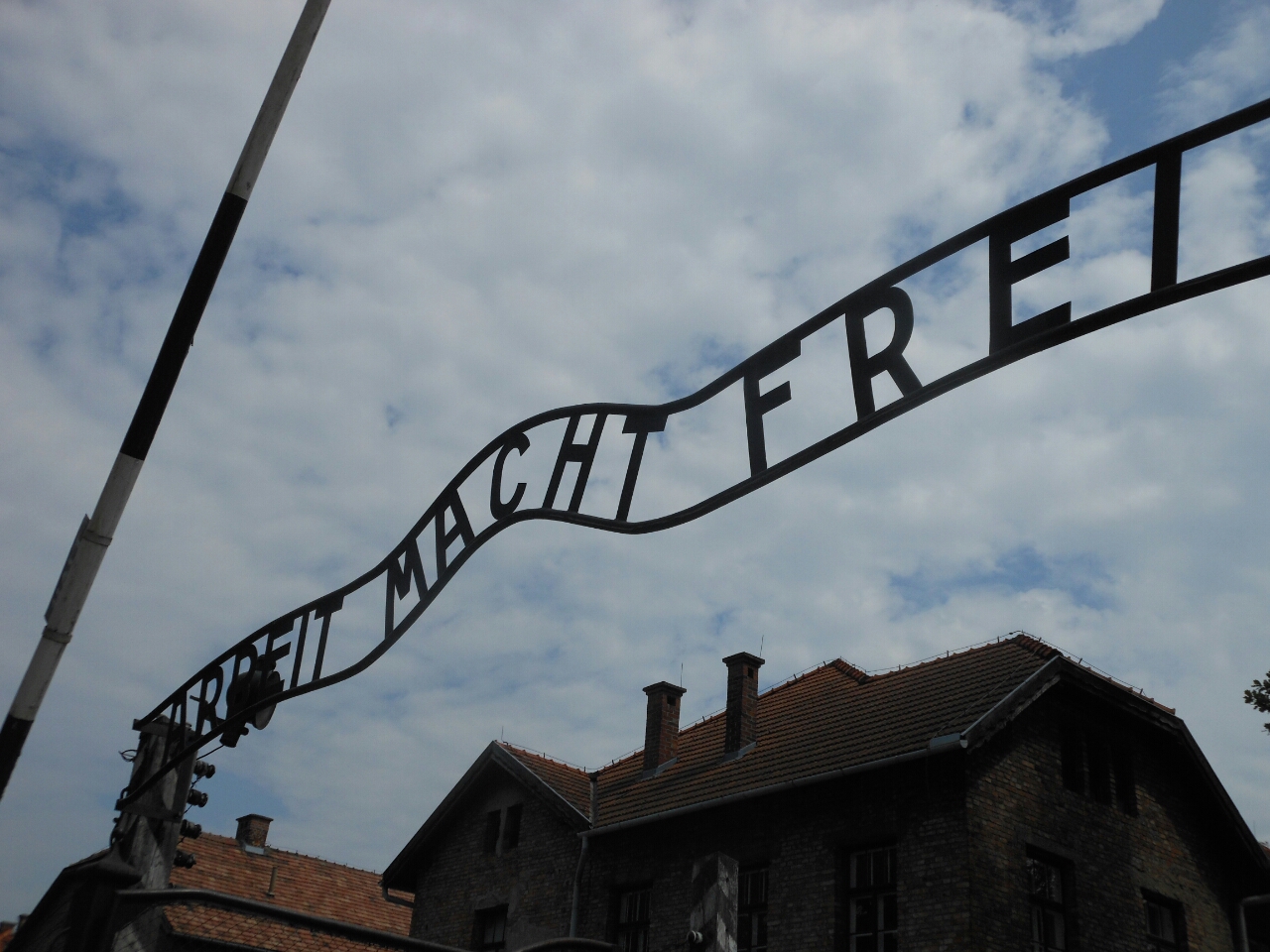
There was quite a sombre mood from the people heading into the museum located at Auschwitz I. Walking out of the entrance building - previously used by the Nazis for administration - the (in)famous "Arbeit Macht Frei" sign is right there, and suddenly the overwelming magnitude of where I was and what had happened there kinda hit me.
Arbeit Macht Frei - "Work Makes You Free" - possibly the most depressingly ironic sign in the world
It all seems unreal when you're standing there. On such a hot, sunny, fine day, the fact that any of the atrocities that happened there - or anywhere else during World War II - could have ever happened seemed completely hard to believe. Entering into the rows of barracks that formed the camp, if you stopped paying attention to where you were, you might think you'd walked down a slightly boringly constructed street.

Some of the barracks in Auschwitz I - what looks like quite a nondescript street, with trees, and the sun shining, was home to some of the worst atrocities in World War II. That's pretty hard to comprehend. 
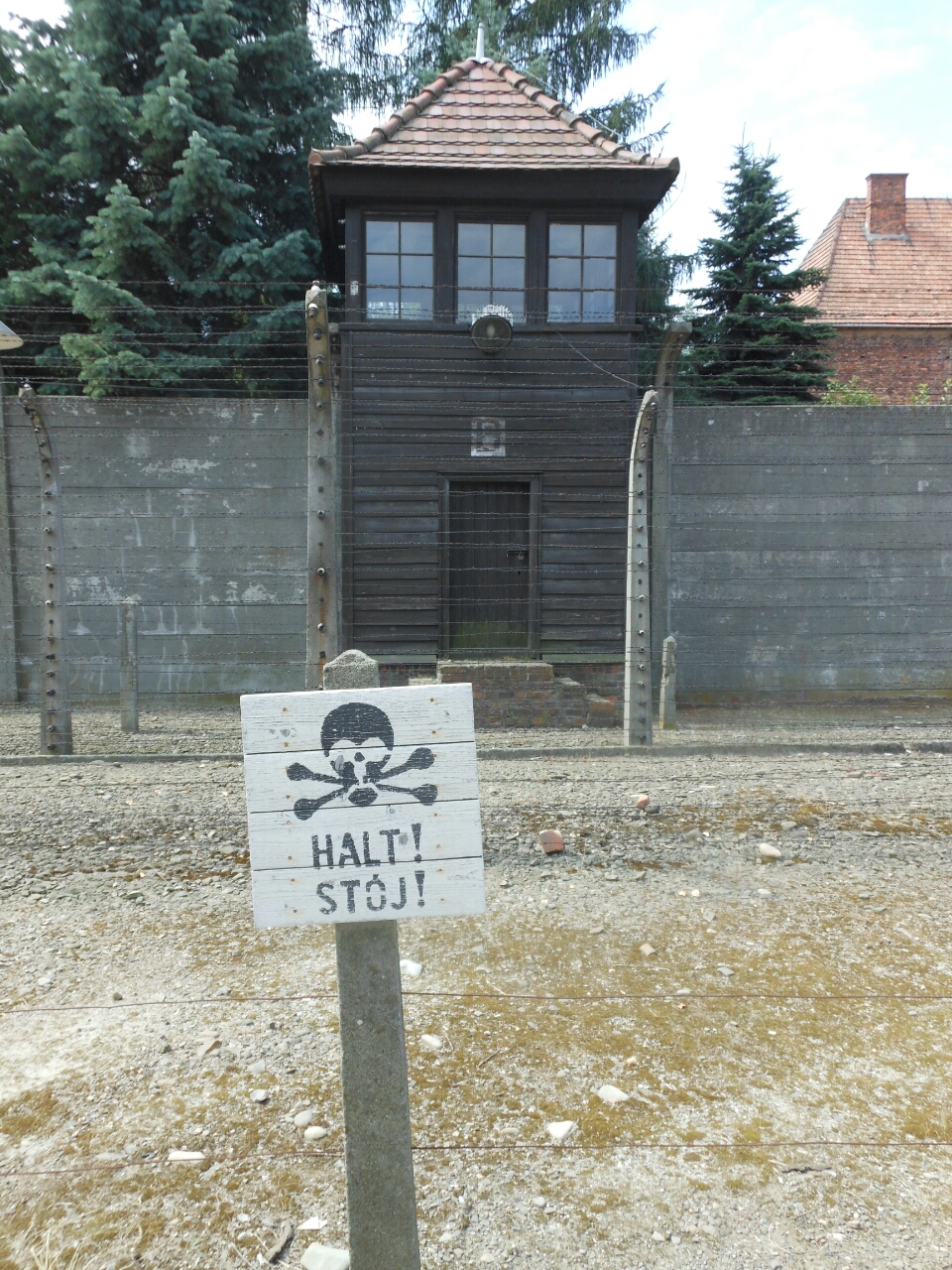
Until you look down the end of the row of buildings, to the guard tower, barbed wire and sign. That reminds you where you are pretty quickly.
The barracks now house a variety of exhibitions on the events that happened out there, representing living conditions at the camp, for example. Most buildings have photographs of prisoners - those for whom a record exists - lining every corridor, with their arrival date and date of death (when known). There were just more and more of these photos in every building, every one of them looking like any other normal person, young and old, male and female. Seeing them one by one, around every corner, only begins to hint at the extent of the number of people murdered here.

One of the most well known (and photographed) is the building containing a collection of items recovered at the site.

Collection of tins taken from Auschwitz I prisoners

Briefcases taken from Auschwitz prisoners
Block 10, towards the end of one row, was the camp hospital. Oh, and it was also used for human "medical experiments".

Block 11, beside it, was an administration building where sentences were passed against prisoners who caused trouble. There are cells beneath the building where one of the punishments involved a tiny cell, about one square metre with a small door below knee height, where up to four (yes, 4) people would be forced to stand for long periods, unable to turn around or sit down.

Standing cell for up to 4 prisoners who required some sort of punishment
Or, if the commander in charge of administering the punishment decided they needed something stronger, he could send them through the door out into the courtyard between blocks 10 and 11 to the "Death Wall", where they would be summarily shot.

That just made me shake my head in wonder and disbelief.

After walking through some of the other exhibits - a number of the countries whose population was affected the most have their own exhibits, and I visited the Dutch and Russian ones - I walked out of the row of barracks - through this double barbed wire fence:

The fence around the barracks - though it didn't used to be able to be possible to walk through
And, looking past the gallows where camp commander Rudolf Höss was hanged in 1947, was this building.

The first gassing chamber at Auschwitz (partially reconstructed). The chimney is for the in-build incinerator.
Suddenly I was very alone - no other tour groups around for a moment. And, all alone, I walked inside that building.

It was haunting, it was quiet, it was dark, it was scary. It was completely overwhelming.

I lasted about 30 seconds until I had to leave, out into the fresh air. I couldn't stand it any more.

I was time for some relief from this place. I left the Auschwitz I camp and treated myself to some time of normality, away from the thoughts and memories of that place. Some deep breaths, some lunch. And then I headed off in the shuttle bus to the other site, the much larger Auschwitz II-Birkenau.

Auschwitz II-Birkenau

Birkenau was, as I mentioned above, a much larger camp built primarily to assist with the Nazi's "Final Solution to the Jewish Question". This was where the majority of the estimated 1 million Jews murdered at Auschwitz were taken - about one-sixth of all Jews murdered in World War II. Many others were taken here and murdered too.

The large majority of those came straight in a train - the tracks were eventually extended to go right into the camp - down a ramp, and straight into a gas chambers.

This is the site I'm talking about, a very well-known image:

The very symbolic "Gate of Death" entrance to Birkenau, the train tracks leading directly inside
(image borrowed from Wikipedia) 
The Birkenau site is, quite simply, huge. It stretches on for 171 ha. Many of the buildings were destroyed by retreating Nazis in an attempt to cover up their crimes from the advancing Soviet army. Some still remain, but large expanses of grass fields are now all that is left of much of the barracks area.

The barbed wire fence is all the remains in the back reaches of the fields at Birkenau
Of the buildings still standing, it was possible to view the insides of a barracks to gain an insight into the sleeping conditions.

Those platforms ("beds") would sleep up to 5 or 6 people. The building would be heated through one pitiful fire in the centre during the harsh Polish winters, and would be sweltering hot during the Polish summers.
I walked down towards the rear of the camp, sweltering in the hot sun. Having drunk several litres of water and still being hot and thirsty, it was somewhat possible to envisage how hard forced work would have been during the summer - for those "lucky few" who were deemed fit to work and not sent directly to be gassed.

The train lines extend through the length of the site, directly to almost the front doorstep of the four massive gas chambers built for just one purpose - the extermination of the Jewish people, the "Final Solution to the Jewish Question".
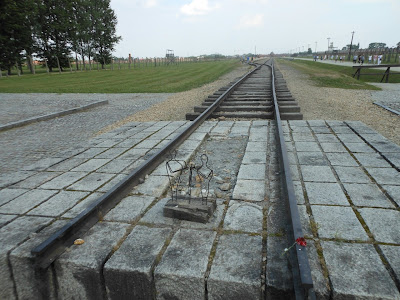
The end of the railway lines, looking down the platforms were new arrivals were sorted into those fit to work, and those to be sent directly to the gas chambers
These chambers were capable of killing - and cremating - up to 12,000 people every day at their peak. All four are in ruins - three blown up by the Nazis on the imminent arrival of the Soviet army, and one that was damaged beyond repair by a uprising of some of the Sonderkommando, prisoners who had the grim task of removing corpses from the gas chambers and cremating them.

Prisoners would enter down a set of stairs into a room where they would be told to undress in preparation for disinfection. They would then enter the "disinfection room" - complete with fake shower heads - with an estimated up to 2,500 people being crammed into the 210 m2 space at once.

The entrance to one of the gas chambers, where several hundred thousand people would have seen their last light of day
The ruins of one of the gas chambers
I sat down to think about it, try and take it all in.

Over the space of several years, some one million people were murdered within 200 m of where I was sitting. Their ashes were strewn in the surrounding areas.

How was that possible? How could anyone have let this happen? How could anyone have denied the basic human right to live to anybody? How did the Final Solution to the Jewish Question manage to become so far progressed?

As I walked past the nearby memorial, I couldn't come up with an answer to any of those questions.

For ever let this place be a cry of despair and a warning to humanity, where the Nazis murdered about one and a half men, women and children, mainly Jews, from various countries of Europe.
Auschwitz-Birkenau
1940 - 1945
The train trip back to Katowice was sombre. As someone put it to me, it was fortunate to be travelling not just to, but also away from Auschwitz on a train.

I couldn't help but think that the warning to humanity referred to on the plaque will not be heeded forever. I could feel the cry of despair.

Monday, 16 September 2013

Czech-ing out the countryside

22 - 26 July

The bus station I needed for Nová Paka was out in Praha's suburbs, so I got myself on the metro, a bit later than I hoped. The bus station wasn't very clearly laid out, and I thought I was going to miss my bus but got there with a couple of minutes to spare and even got the last spare seat. I was quite clearly the only non-Czech person on the whole bus - probably in the whole station - and starting to wonder whether my desire to go somewhere off the main tourist trail was a bit too adventurous for someone who couldn't speak a word of the local language... Hopefully Český Ráj ("Bohemian Paradise") would live up to its name...

Nevertheless, I arrived in the small town of Nová Paka, from where I had a 25-minute walk to the 2-star hotel I'd madly booked myself into right out on the edge of town. It was mid-30s degree heat, and uphill, with no shade, and by the time I got there I was very hot & sweaty. Then I encountered a new challenge... No-one at the hotel when I arrived could speak hardly any English...

They figured out that I must be the reservation with a non-Czech name, but when it came to pay I realised I didn't have enough money with me. Trying to explain I would go to the ATM and pay the rest tomorrow proved a real challenge to someone I had no common language at all. Eventually she worked it out, and I even managed to get a wifi password... My first priority was then to learn a couple of Czech phrases - something that hadn't been needed in the tourist-filled Praha.

The next morning for breakfast I discovered the manager was there, who did actually speak some English, and the menu had an English translation even. I discovered that in the general area, locals were more likely to speak German, and signs may have German translations, since it is quite close to the German border in the north of the Czech Republic.

Enough talking - time for some photos. The idea was to do a few day trips around the area, and so -  armed with detailed directions and a photo of a map this time! - I headed for the ruins of Kumbruk Castle. It was another hot day, but the views across the countryside were quite impressive, and the ruins of the castle provided a good opportunity for a little explore.

The quiet calmness of the Czech countryside
Looking out of a window of the Kumbruk Castle ruins
Castle ruins
It was a good 6-hour return walk, however, so the evening was another quiet relaxed one - though to be fair, there wasn't exactly a nightlife to be had in Nová Paka! The next morning I took a bus to Jičín, a slightly larger town, and discovered an actual tourist office that spoke English. From there - now armed with an actual paper map - I headed for one of the so-called "rock cities" that make the Český Ráj area famous. A 1.5 hour walk up a hill led me to Prachovské Skály. I spent some three hours walking around the site, which provided many opportunities for good views and photos.

Rock towers poking out of the trees
Me in front of one of the larger rock towers, to give you a scale...
Some of the massive rock towers
Around the rock city
One of the lookouts over the rock city
View from atop one of the rock towers out to Jičín
A narrow gap the trail led through
Briefly, the geology is something like this: the area used to be under the sea. Tectonic processes uplifted the sandstone, which broke into several separate blocks around the Český Ráj region, one of which is Prachovské Skály. The tall rock towers and deep gaps were essentially then formed over time by erosion processes.

I ended up in Jičín for dinner, and found a restaurant with an English menu - and prices less than half than what an equivalent place in Praha would have charged. The waitress was fascinated by an English-speaking customer in Jičín and even more fascinated when I said I was from New Zealand, and since the restaurant was still quite empty, I got into a big conversation with her because she wanted to practice her English!

Back in Nová Paka for my last day there, and having done two big day trips, I satisfied myself with a big sleep in and trying to catch up on my journal and blog. I also was trying to work out how to get to my next destination - Katowice in Poland - which was proving a lot more difficult than I'd hoped. It must be said that researching accommodation, buses, trains and so on can be very tiring, and it's a never-ending process while backpacking around Europe.

Nová Paka had one last surprise for me though... This amazing sunset I saw out my window on my last night...

Not a bad sight, really...
The next morning I got a bus off to the Stará Paka railway station and went to buy my ticket to Katowice. The poor woman at the ticket office had probably never had a mad New Zealand backpacker trying to book a train ticket to Poland before and couldn't speak any English. When it turned out I didn't have enough Czech crowns left, nor enough Euros, and there was no electronic card facilty, it got a bit complicated, but I eventually paid in a combination of Euros & Crowns.

The tiny train got me to Pardubice, where a man in the information booth used Google Translate to tell me I needed a seat reservation as well, which I eventually got from the ticket office. While I survived, I'm not sure I'll ever be as optimistic travelling to out-of-the-way places when I can't speak the local language!

After leaving Nová Paka at 8am, I finally got to Katowice late afternoon and got dinner with an American girl from the hostel, who'd been to Auschwitz the day before. That was my plan for the next day, and given the sombre nature of the day planned, I headed to bed pretty early.

Czech-ing out Praha (Prague)

18 - 22 July

I had a mid-morning departure from Berlin to Praha*. The train was reasonably high-speed within Germany and slowed down noticeably once we entered the Czech Republic, presumably due to the tracks - but the scenery along the Elbe River gorge meant it was quite nice going slower. Unfortunately I was on the wrong side of the train... (sit on the left Berlin-Praha or right Praha-Berlin)...

* Praha is the name in Czech for Prague. I've noticed many cities around Europe are different in the local language, and I've been trying to use the local name as much as possible. Prag (German & Danish amongst others), Praga (Spanish, Italian, Polish, Hungarian, Russian) and Praag (Dutch) are other variations here.

The arrival in Praha was mid-afternoon and somehow my hastily-scribbled directions for the 20-minute walk to the hostel actually worked through some of Praha's narrowest labyrinth streets. Who needs a smartphone with Google Maps anyway?

I spent the rest of the afternoon generally relaxing and planning my time in the city. I've heard of Praha many times - how amazing a city it is to visit - but actually, what was there to do for 3.5 days? Well, it's a city of gorgeous architecture, straddled across the Vltava (cue confused pronunciation) River, with quite a famous castle up on a hill with gorgeous views of the spire-covered city... As you'll see below! For my first night, though, Praha has some neat little jazz bars, and I found an excellent blues gig going on in a brick basement smaller than my parent's living room...

U Malého Glena bar - not my photo, off the website, but you get the idea
The next morning I headed off towards the famous Praha Castle (Pražský Hrad) that sits majestically on a hill overlooking the main part of the city. While it may not look exactly like a typical medieval German castle, it's still quite the spectacle and an excellent spot for a view over the city. Being a castle and a big tourist attraction, they do, of course, have to have guards mimicking London's...

Pražský Hrad from the other side of the Vltava River
St Vitus Cathedral (Katedrála sv. Víta) within the castle grounds
View over Praha Malá strana ("Lesser Town") - and my long-needed haircut
No beefeater, perhaps, but still gotta get a photo
Changing of the Guard
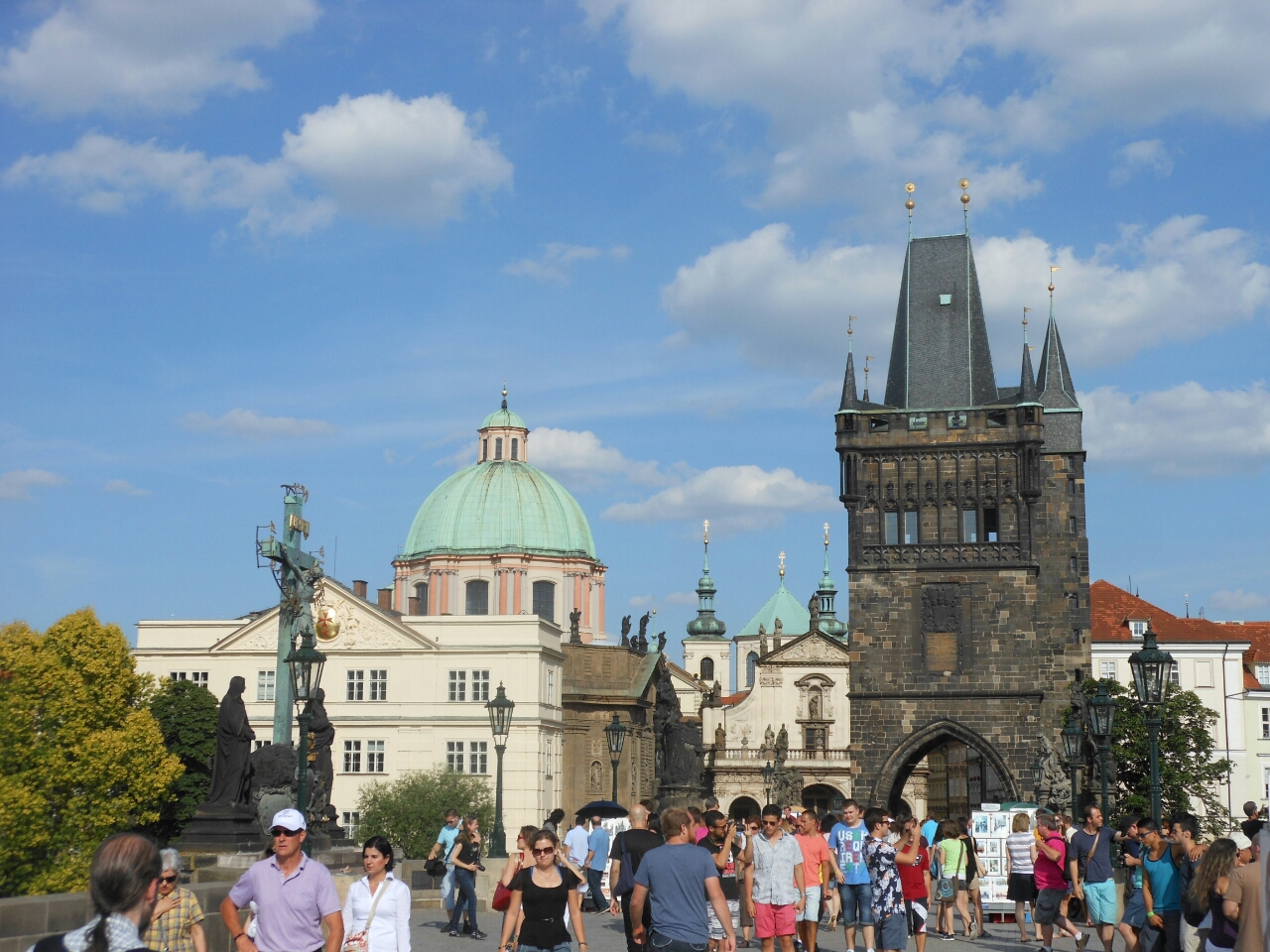
Unfortunately it cost a fortune to go inside any of the buildings, so I contented myself with a view from the outside and after lunch headed to a large park on a neighbouring hill for some journal writing and more good views - including of the castle. Heading back from the Malá strana "Lesser Town" side of the river to the Staré město "Old Town" side of the river, I walked across the well-known Charles Bridge (Karlův most), dotted with old statues, lots of tourists and lots of touts and vendors. The bridge is named after a Bohemian king and dates from the 15th century. It was originally simply called Stone Bridge (Kamenný most).

Charles Bridge
Charles Bridge and the tourists!
I spent the evening mainly researching some other place to go in the Czech Republic, having decided it would be nice to get out of the city for more than just a few hours at a time. It wasn't that easy though and Google Translate seemed to be taking me around in circles, but I settled on an area called Český Ráj, and then just had to figure out how to get there and where to stay - more about that in the next post!

I spent the next day exploring the Old Town, mainly around the main square. Praha was thankfully rather spared during World War II and many of its impressive architectural gems are still standing. Even though I've now seen such buildings in many cities all over Europe, they still impress me, being so much older and more impressive than almost anything in New Zealand.

St Nicolas Church (actually in Lesser Town)
Praha is a busy place in the middle of summer - and very hot too. Main square with Týn Church behind.
Just like any other building you see, really.
Main square
Astronomical Clock - the oldest functioning one in the world, dating from 1410
Back at the hostel I had a full room of new arrivals, and 3 Canadians introduced themselves and asked if I'd like to head out with them that night. Funnily enough, despite being a historical and architectural gem, Praha is also renowned for its nightlife scene, so I agreed and we ended up at a massive 5-storey club on the riverfront, with each floor dedicated to a different music genre, including a chill-out ice bar floor. I managed to lose them - an easy thing to do in the crowded place - but ran into the group of British Singaporeans I'd met in Berlin several days earlier, and didn't head home until the wee small hours.

As nice a city as Praha is to walk around, there are a limited amount of things to see, so I decided on a day trip out into the countryside to see Karlštejn Castle (Hrad Karlštejn). After receiving an email from Mum saying they were all safe after a reasonable-sized earthquake back in Wellington, I headed off on the somewhat run-down local Czech trains. As I walked through the small village of Karlštejn the castle suddenly appeared from behind the hills...

Karlštejn Castle
The views from on top were pretty impressive too...

From inside the castle with the Karlštejn village in the valley below
Close up of the castle
I took a tour through some of the interior of the castle, which was interesting, but tour guides can be a bit hit-and-miss, and this one seemed to be boringly reading from a script. We did get to see old throne and bed of King Charles IV (the same king of the Charles Bridge), his secret passage to the queen's chambers upstairs, and a replica of his crown. It was a pity photos weren't allowed.

The ever-faithful internet told me there was an interesting walk available through the country to a monastery and town to another town to catch the train home from, so I headed off to do that. It seemed however that trail markings weren't that great and I found myself on a quickly-disappearing trail that unexpectedly gave me this view back at the castle through the trees...

The castle rising up out of the foret...
I headed back and followed a road that seemed to go where I wanted, though when I stumbled across an unexpected village I discovered I'd gone quite the wrong way. A very helpful (English-speaking!) local on a bike gave me his map and pointed me in the right direction.

Unfortunately the route he pointed me on went just off the map, and I took a wrong turn somewhere along the line. I ended up on a track that didn't seem to be a main one at all, and without anyone to ask where I was, I knew that the direction it was taking, downhill towards the river and railway line, would eventually come out somewhere. I was, however, completely lost and also running out of water on a very hot day.

Wishing that I hadn't been quite so optimistic in finding directions from a random website, I was thinking about how stupid I really was to end up in the situation I was in when I came across a stream - water! - and also the path I'd originally meant to follow to the monastery, very clearly marked. Somehow I must have missed the turn-off, or been on the wrong place to start off with. I followed the path and found the monastery - not that impressive a destination ironically - and the town for the train back home. Lesson learnt - always take a map!

After the longer-than-expected day, and with an early bus out in the morning, I made it a quiet one for my last night in Praha.