Sunday, 8 September 2013

Willkommen in Deutschland

14 - 18 July

Note - this blogpost talks about some pretty depressing stuff from World War II & the Berlin Wall.


After a long train ride through much of the German countryside, I arrived into Berlin in the late evening. Somehow sitting in a train for 7-8 hours makes you quite tired, even though you're not doing anything, so I just had a quiet night at the hostel with a couple of beers with a guy from my dorm room.

Berlin, despite whatever has happened in it's past, is now well and truly known as a vibrant, active city with very good nightlife. I found this out on my first night, indirectly - the group of 4 Irish girls sharing my dorm went out as I went to bed, around 11.30pm, and arrived home after I'd woken up from a good night's sleep at 8.30am...

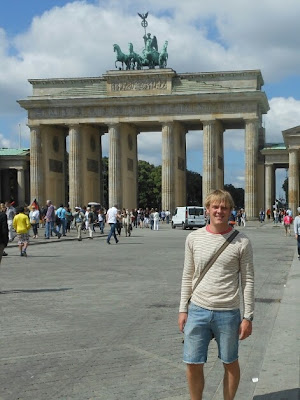
Everyone knows there is a lot of history in Berlin, most of it considered pretty bad and there certainly are a lot of very sobering moments in Berlin's more recent history. I started off with a couple of the famous sights though - the Reichstag parliament building and then the Brandenburg Tor - warning, typical tourist shot coming up...
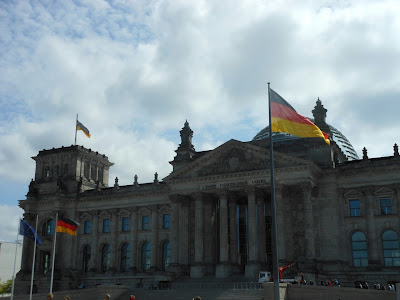
German Reichstag (parliament building)
Parliament sittings were held here until 1933, when it was severely damaged by arson fire not long after Hitler was named Führer. It remained out of use right through WWII and the Cold War, with West Germany's parliament sitting in Bonn. It was refurbished after the fall of the Berlin Wall and has been used again since 1999.
I visited the large dome at the top later in my trip...
And... Typical tourist shot at the Brandenburger Tor (Brandenburg Gate)
It's pretty sobering, though, reading some of the history behind just that gate. It was on the border between East and West Berlin after the war and is now, of course, a very important symbol of both the division of Europe during the Cold War as well as unification of Europe and Germany after it. And you don't have to go far to find another sobering site - the very directly-named Memorial to the Murdered Jews of Europe.
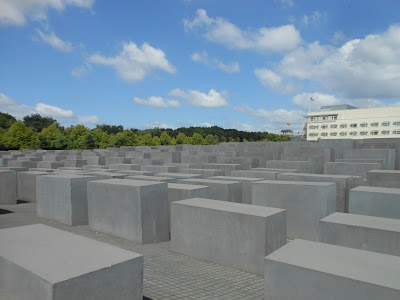
Memorial to the Murdered Jews of Europe
Walking around in thoughtful contemplation inside the memorial
The site is meant to be open to anyone's personal interpretation, and I wondered if perhaps every inch of height of each one of the blocks might represent a murdered Jew. Maybe even every centimetre. Or millimetre.

Makes you think pretty hard about what happened.

It was a bit sad though about the behaviour of some people in around the memorial. It's possible to climb on the blocks, and play games running around inside them, and quite a few people were not really giving the site the respect it deserves. Why parents think it's a good place to take 7-year old children, I'm not quite so sure.

From there I made my way to the Topography of Terror displays. There was a lot of really detailed information on the Nazi terror inflicted on the German people. Something I hadn't realised previously was the extent of the terror of the Nazi regime not just against Jews, but also against gypsies, disabled people, anyone who voiced opposition to the regime, and many other groups of people. It was very difficult to take in, standing in 35°C sun, people walking past on the footpaths laughing, talking on mobiles, wondering about their next meal or who would win the football match that night. It seemed impossible that this could even have happened.

Terror in Germany didn't end with the fall of the Nazi regime and the end of World War II, of course. The Communist-run East German regime implemented all sorts of hard-line policies during their reign, most notable of all forbidding anyone from leaving the country without a (very hard to get) pass. This did, of course, lead to the Berlin Wall, and the most famous checkpoint on the wall was into the American sector of West Berlin at the so-called Checkpoint Charlie. This really was a tourist grab-a-photo spot...
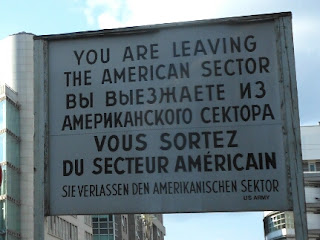
Everyone knows this sign...
After spending so long reading information at the Topography of Terror, it was pretty late, so I headed back to the hostel and got some dinner.
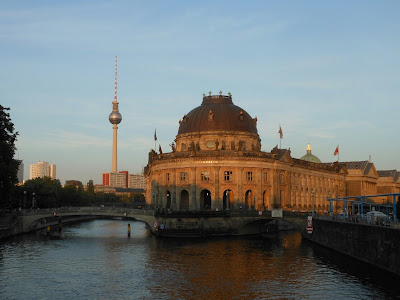
Dusk view of Museumsinsel (Museum Island) on the Spree River
I then walked back towards the Bundestag buildings, just across the river from the Reichstag. As it gets dark, each night during summer, they show a free short film projected up onto the side of the Bundestag buildings. If there's one thing you have to say about things in Berlin, is that they're not afraid to discuss what happened in the past. The movie was quite the light show, and also very interesting.
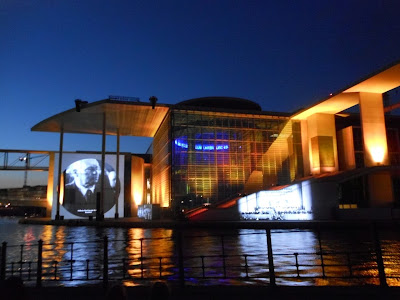
Short film being shown at the Bundestag
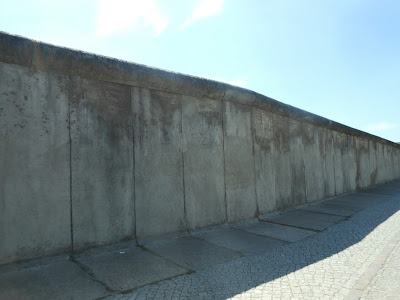
Having spent most of my first day at places related to the Nazi regime, I headed the next day for Bernauerstrasse, home to the largest remaining stretches of the Berlin Wall from the Cold War Soviet regime. As I alluded to before, the wall was built by the East German government to keep people in, not out. Over the years it was developed from a wire chain-link fence to two large concrete walls, with a no-man's zone in between patrolled by regular guards. Anyone trying to escape was seen as an enemy to the state, and that was justification enough to try and shoot them down.

Bernauerstrasse had an excellent set of displays, with photos of the places you were standing when the wall was there, and markers showing the location of the wall all the way along. There were also descriptions of attempted escapes, by the border guards themselves, by tunnels, by jumping out of windows of buildings on the wall before the no-man's zone was built.
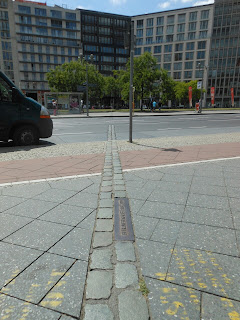
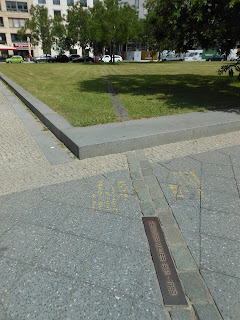
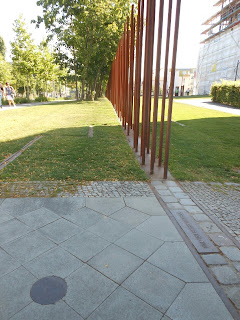
Paving like this marks the location of the wall throughout Berlin's centre
More markings
Markings of the line of a tunnel under the wall
The line of the wall with an "event" plaque - there are lots of little round plaques like this noting where "events" occurred, such as a successful escape or a gunning down by wall border guards.
A mock-up of the no-mans land between the two sides of the wall with a guard tower
Can you imagine looking at this for over 30 years, on the route you used to walk to go to the market or to school?
On my way out I also went through the Nordbahnhof metro station, which had a display of attempts to escape through the subway stations - since one of the metro lines (built pre-war) passed from West Berlin into East Berlin and back to West Berlin. The stations under East Berlin were boarded up and patrolled by guards and the trains passed through these "ghost stations" without stopping.

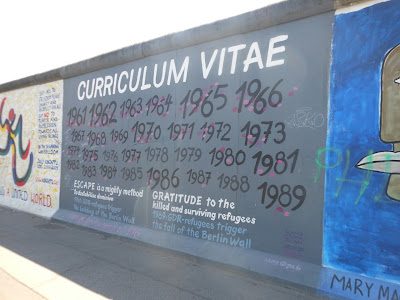
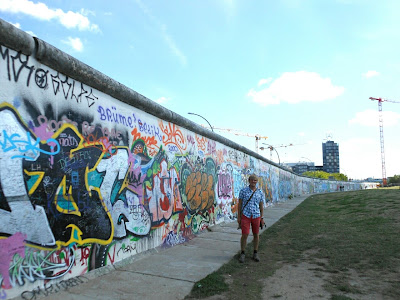
From there I took the S-bahn metro to the East Side Gallery, a long stretch of preserved wall that has been painted by various artists with symbols of peace, hope, prosperity etc. Some of the paintings were quite impressive. The reverse side is covered in free-lance graffiti, and many visitors add their own little message here.

East Side Gallery
East Side Gallery
The reverse side of East Side Gallery
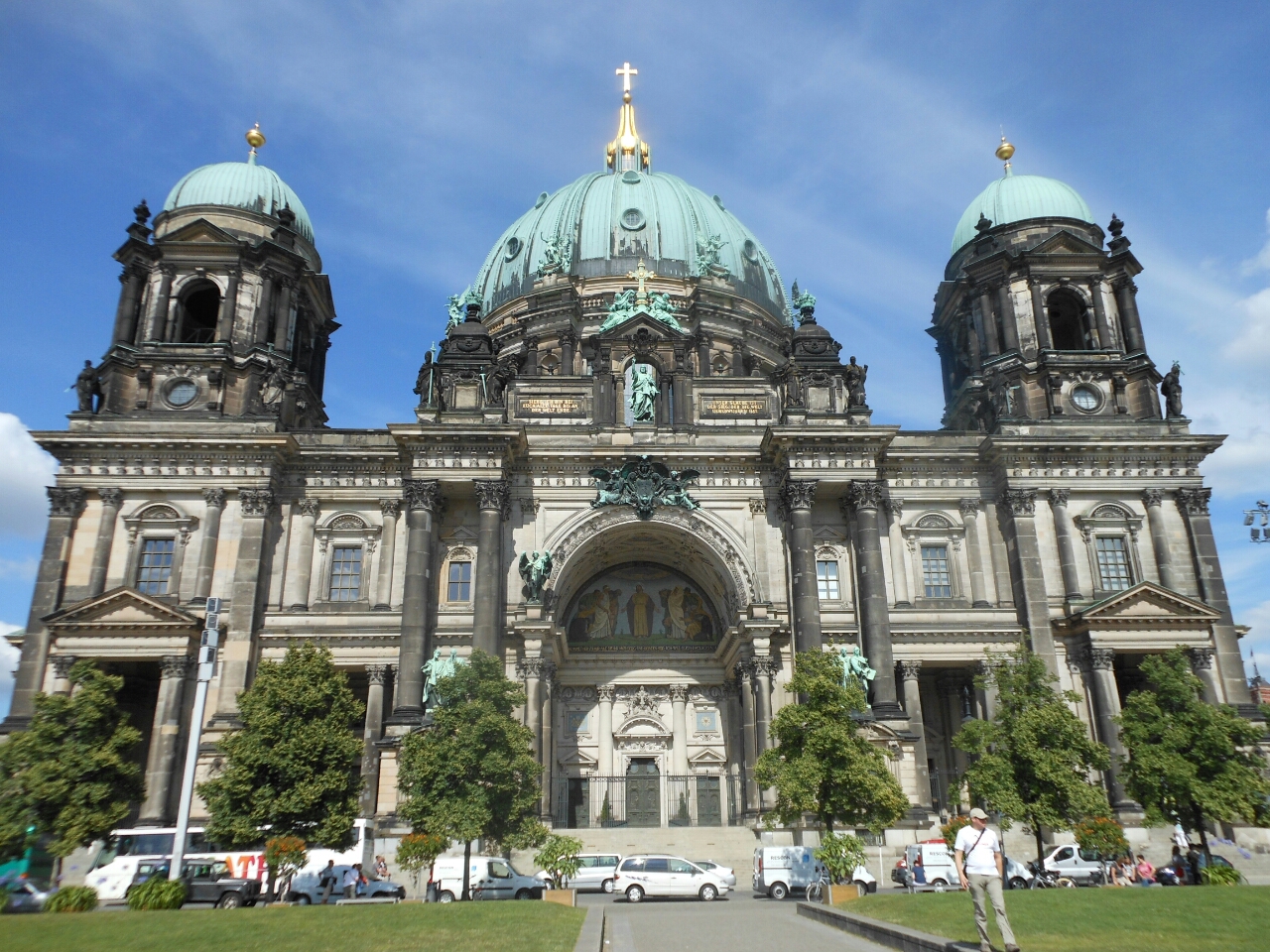
After that I walked to & around Alexanderplatz, roughly the city centre and where some older buildings can be found - there weren't many left after the war.
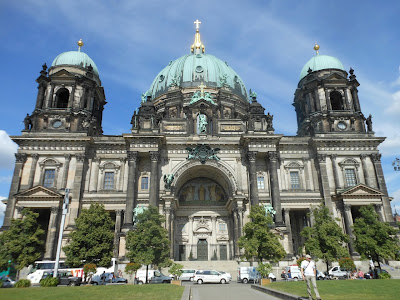
Berliner Dom
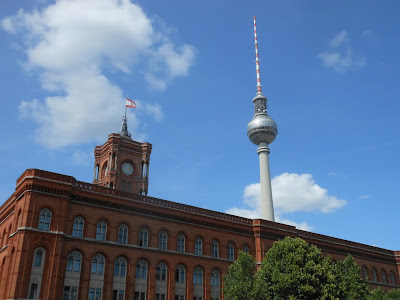
Rotes Rathaus (Red City Hall) with Fernsehturm (TV Tower) behind
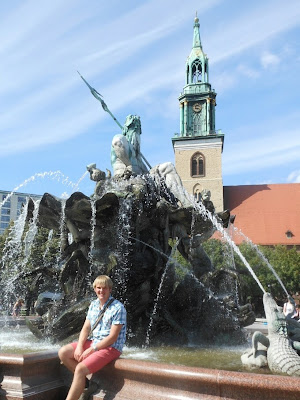
Neptunbrunnen fountain & Marienkirche (St Mary's Church)
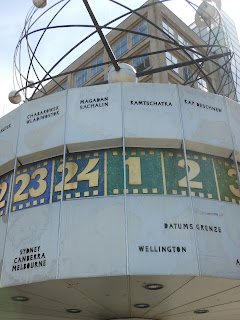
World Clock in Alexanderplatz - it was 1:20 am in Wellington!
I got dinner with a roommate from the hostel - mmm, falafel - and later that night headed out with a few Singapore-based British students for a small taste of the Berlin nightlife.

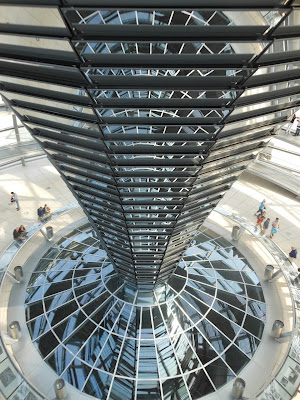
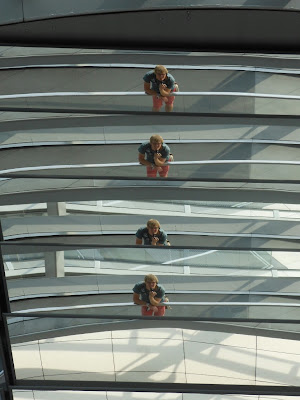
I had a couple more things to look at on my last day. First was a trip to the dome at the Reichstag building - free, but you had to book in advance. There was a good audio-guide on the sights to see and a good view at the top. Inside the dome, a complex set of mirrors reflects light down into the debating chamber directly underneath - and also allows for some creative photo-taking...
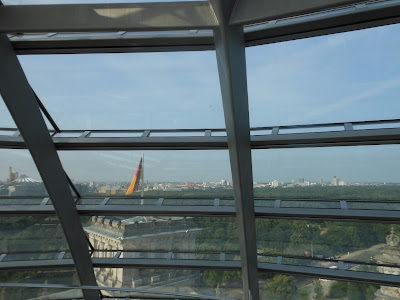
View out over a park from within the dome
The mirrors that reflect natural light down into the debating chamber
And the creative photo-taking (that's me!)
From there I visited the information centre at the Memorial to the Murdered Jews of Europe I'd visited several days previously too. This was really quite direct and hard-hitting... I don't think I've ever been anywhere where so little was said. Everyone was just reading in silence, trying to take in the scale of the Nazi atrocities against Jewish people and others. Once again, after looking around at the view from the Reichstag Dome in the sun, this was such a contrast in feelings and emotions, not just of myself but everyone around me.

It seems Berlin really is a city of contrasts like this - a very vibrant, accepting, open, forward-going city with a very chequered past that they're not afraid to talk about.

I said a few weeks ago that museums aren't generally my thing unless they've got a specific purpose or interest. All of Berlin's museums fall into this category, and there were two more I wanted to visit. The small Stasi museum described the hard-handed East German police forces and some of the crimes they committed during the existence of East Berlin and East Germany. While the extent of murders might not have been on the scale of the Nazi regime, they certainly weren't afraid to suppress any form of resistance against the communist rule.

The last one I visited was the Jewish Museum. This described the whole history of Jewish people and the religion. Since being there I've visited many other European cities, many of which had their own Jewish ghettos or districts, and the scale of discrimination against Jewish people extends back for many hundreds of years into history. It really is sad, and while I'd like to think that today's world isn't like that, I know that it still goes on in many places, both out in the open and hidden away in the more minor extents such as school playground bullying.

---------------------------------------

I know this has been a long blogpost, but I think that reflecting and sharing some of my thoughts from visiting Berlin is important. I think the city does very well to try and live in the present, while also displaying its chequered history for all to see and understand. Some true atrocities really did happen here, and it's such recent history that makes it so hard to fathom. The Berlin Wall was still standing in my lifetime. My parents travelled with me (as an infant) in Western Europe while the wall still stood.

How did the world let this happen? How did leaders such as Hitler or Stalin think it OK to make these things to happen? And this is only one of the most public, well-known occurrences in recent history. What about Syria? What about Palestine? What about Pol Pot in Cambodia? What about apartheid in South Africa? This is only a tiny selection of the atrocities that have occurred in this world, and many more will continue to occur, despite anyone's best attempts, in my lifetime, your lifetime, and our children's generation and our children's children's generation.

I could apologise for the pulling of heart strings, but visiting Berlin really made me think about these things, and I think we should all think about these things from time to time.

---------------------------------------

With that, I made it to a open jazz jam gig on my last night in Berlin. Then, it was up early the next morning for a train to Praha - or Prague, one of the jewels of Central Europe.

Wednesday, 4 September 2013

The highest area in the Low Country - Maastricht

09 - 14 July

I took an early train out of Bruxelles to Belgium's east, and then again across the border into the Dutch south and the city of Maastricht. Situated in a little piece of land between Belgium and Germany, the city is quite popular with students and is in the highest part of the Netherlands - the city is at a whopping 60 m above sea level!

About the only border sign I saw was this on the side of the road indicating that speed limits are different in The Netherlands...
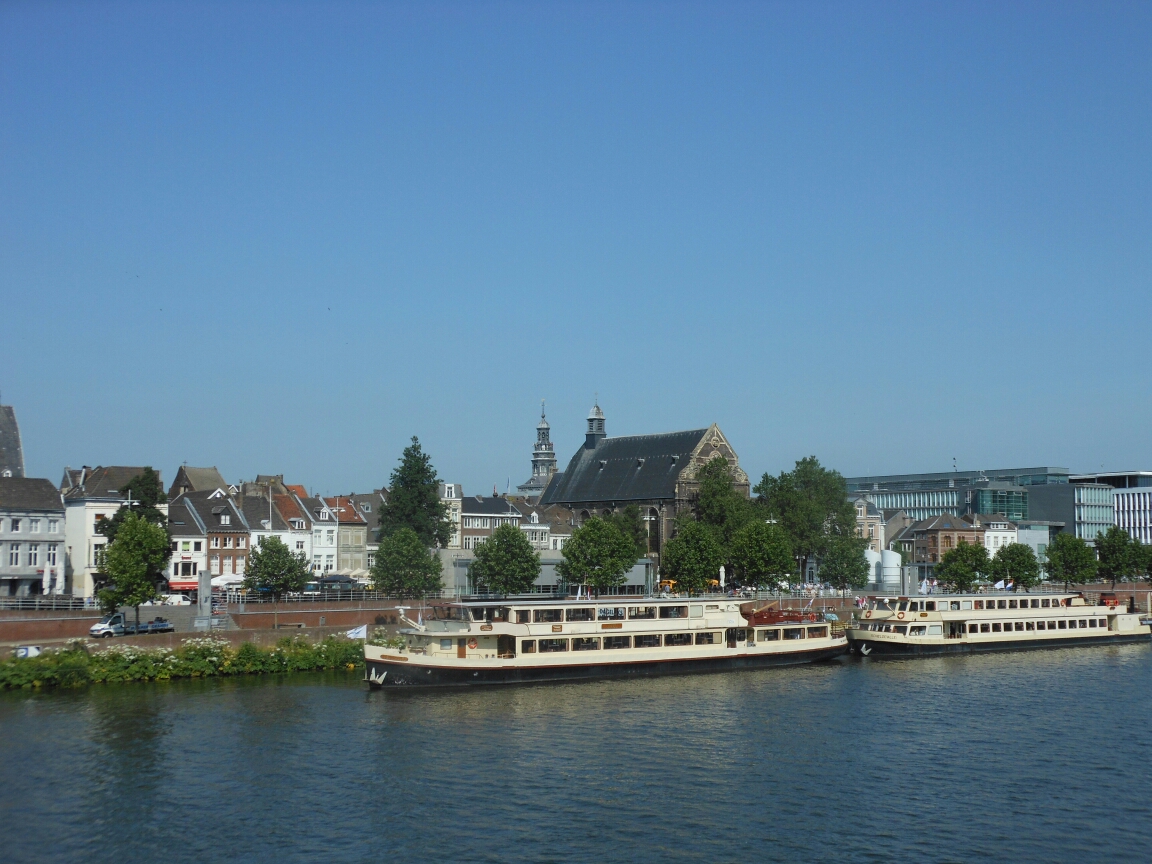
Maastricht is known for being a very beautiful town, and as I walked from the train station to my hostel I could see why - in the sun the town centre, spread out on either side of the Maas River, looked very idyllic. I think I could definitely imagine myself living there in retirement... One day!

Trainspotter's note: The Maas River (or Meuse River) used to drain through Rotterdam's port Maasvlakte (I was there several weeks earlier), but now takes another course due to a combination of effects after flooding and also river engineering works. The river flowing through Maasvlakte is now the Nieuwe Maas and isn't hydraulically connected.

View of the Maas
Isn't that just idyllic?
I spent the afternoon just relaxing - I'd crammed quite a lot into several days in Bruxelles and it was nice just to lie down in the sun. I'd started a scrapbook of tickets, leaflets and other little things so I lay in the city park doing that for a while, along with many others (including lots of students) out enjoying the fine weather.

Maastricht is also known for two treaties. The first Maastricht Treaty was signed to determine the border between The Netherlands and Belgium when Belgium became a separate country in 1843. The second Maastricht Treaty was signed much more recently - it was what created the European Union in 1992 and was also the precursor for the Euro currency 10 years later.

I spent my first full day in the city exploring around on foot. I found some old battlements and also climbed up the hills behind the city, through the countryside a bit, where I discovered a cute countryside church.

Set & run photo-taking fail - when I slipped over - at Maastricht's old city fortifications
Gorgeous little countryside church
View back towards Maastricht township
The afternoon was spent planning the next part of my European soujourn - it was time to head east but I had very little planned from after I left The Netherlands. Once I had a train booked to Berlin, it was back out to the park to enjoy the sunshine and later a beer on the hostel's riverside balcony.

Not a bad spot for an evening beer really...
Dusk by the Maas River
The next day I had a mini day-trip planned down to the Drielandenpunt, which is the three-way border between The Netherlands, Belgium and Germany. After a Skype call back home for Mum's birthday, I took a bus to Vaals and walked up the hill to the highest point in The Netherlands, at 327.5 m. The point is very close to the three-way border, marked by a few tourist shops and cafes and a small marker point.

The flags of (L-R) Germany, The Netherlands and Belgium near the 3-way border, photo taken in the Netherlands looking towards the German town of Aachen
The three lines are the borders... I may have a foot in Germany (right foot) and Belgium (left foot), but my head (& heart!) are in The Netherlands!
After that I went for a short walk down into Belgium, back up to the borders and then headed down on the German side towards the town of Aachen. Once again, just over an imaginary line, everything was in a different language - it's still a bit weird to comprehend really.

Once getting down to Aachen (or Aken in Dutch), it was a short walk back along the main road into Vaals and The Netherlands, and a bus back to Maastricht. When out for dinner that night I finally found the strange red church I'd seen from the distance the day before:

Sint Janskerk, apparently painted red by the Canons of St Servaas in the Middle Ages to indicate their ownership
The next day I packed everything up again and headed back to Made for two more nights with Oma, Opa & Tante Cock. It was a reasonably quiet couple of days, but also my last two days before heading east towards Germany and onto Central Europe, where I would be travelling by myself, in hostels most of the way. So I appreciated my last home-cooked meal for a while, in the sun on the balcony.

Dinner with Oma, Tante Cock and Opa on the balcony in Made
I also found out one of the friends I'd met in Cusco, Jantien, lived very nearby, in Etten-Leur, and had just recently got back from South America, so we took the opportunity to catch up for lunch and a beer. I hadn't actually been into Breda yet but the centre was bustling with people enjoying the Saturday afternoon sun.

And then, the next morning, it was back to the train station for the long ride to Berlin - time for a set of completely different experiences again...

Tuesday, 3 September 2013

Bruxelles/Brussel, a true international city

06 - 09 July

I arrived in Bruxelles mid-afternoon, with a sudden transition from the Flemish-speaking to the French-speaking (mainly) part of Belgium. It's a bit strange being in such a multi-lingual country - all the politicians, the king, and many of the residents speak at least some of the other language to their natural one, and of course many of them speak very good English too. After speaking to Els' Mexican friends in the morning in Spanish, I managed to be using words in four different languages during the day - and it also marked six months since I'd flown out of Wellington way back on the 6th of January.

I also suddenly realised how badly my French had deteriorated since leaving school - and probably more so since learning Spanish. I found myself asking for "dos" instead of "deux", wanting to say "gracias" instead of "merci"... However I walked into town for a brief look around - it was a gorgeous city centre - and got myself a Belgian beer (they make them good around here) to soak in the atmosphere of a true international city.

First thing the next morning I headed on the metro to the Euro area of Bruxelles, home to the European Union (EU) Parliament among several other important EU buildings. A very good exhibition, Parliamentarium, depicted the history of European collaboration and the EU since the late 1940's, right from the initial stages of conception through to the acceptance of Croatia as an EU member just a week previously.

Sign on the European Parliament building in all official EU languages
Bruxelles also has it's own Arc de Triomphe, built in the Parc du Cinquantenaire (French name) or Jubelpark (Flemish name). The park commemorates 50 years of Belgium as a country - it was previously part of the Dutch empire until the 1830 revolutions - and, like everywhere in Bruxelles/Brussel, has two names in the two languages.

Arc de Triomphe/Triomfboog
The Royal Musuem of Art & History is attached to one wing of the arch, and the Royal Museum of Armed Forces & Military History is on the other wing, which is where I headed next. Free museums are always a good attraction, and this one had some very good exhibitons, including one I found particularly interesting on World War II. Some of the main signage was in English, but much of it was only in French or Flemish, which I found I could pick up about 80% of in combination. They also had a huge hall full of old planes...

Impressive hall of old military planes
The museum also had a lift up to the top of the arch, which afforded a pretty amazing view of the city:

View from the top of the arch
On the way back to the hostel I stopped off at the Stripmuseum, as it's called in Flemish - a bit misleading perhaps to English speakers when it's actually a comic strip museum. They had a lot of displays of some very successful comics through the years, including, of course, the creator of Tintin, a Belgian who went by the name of Hergé. This, I discovered, was actually his pen-name, a spelling-out of RG in French, being the initials backwards of his true name, Georges Rémi.

The next day I headed out to the site where Bruxelles hosted the World Expo in 1958, mainly to get a quick look at a rather impressive, massive sculpture, the Atomium:

The 102 m high Atomium - re-shined in 2006
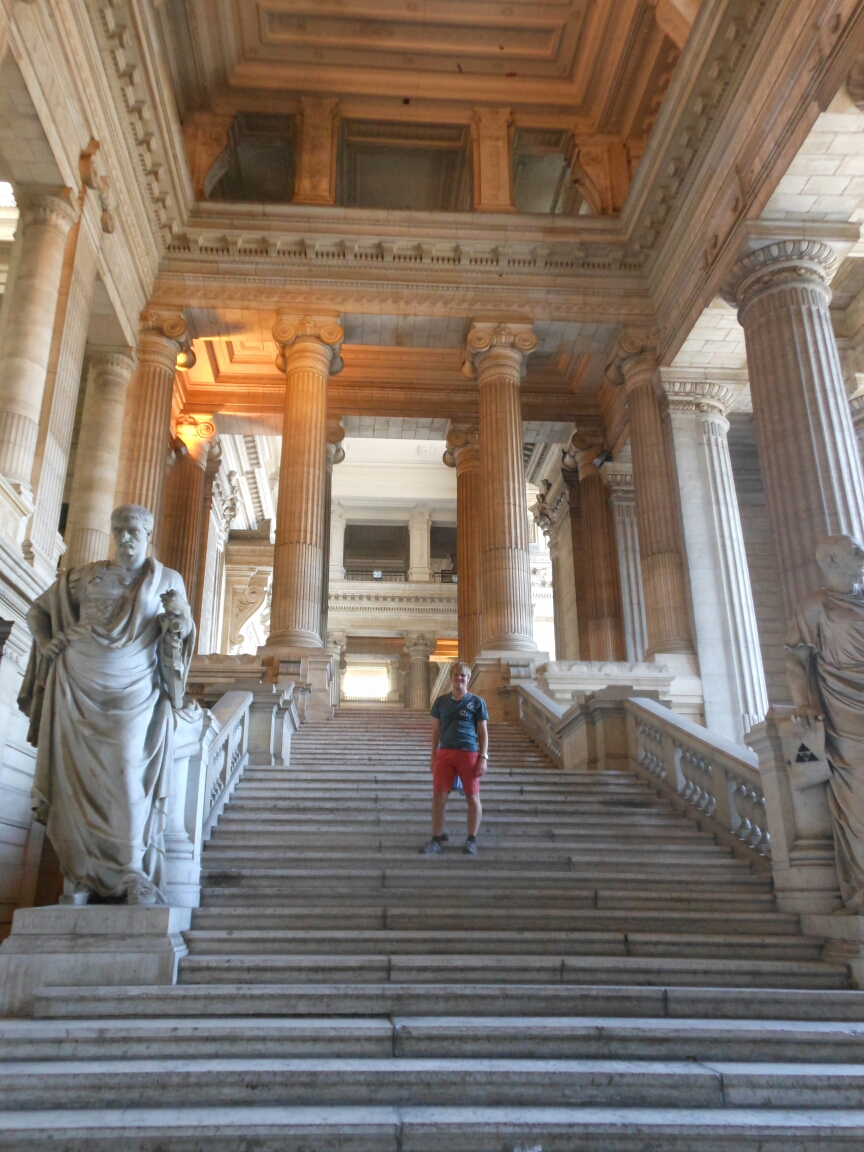
Back on the metro I headed to another corner of town - Bruxelles is a pretty big place of attractions to get around! - and found the Palais de Justice/Justitiepaleis. A pretty impressive building on a little hill with a nice view, it was unfortunately also inflicted with a pretty common sight around Europe, it seems - scaffolding for repair works. However the entrance hall was still just a bit grand...

Entrance hall in the Justice Palace
I had lunch in the Parc du Bruxelles/Warandepark and caught up a bit on my journal - it's getting notoriously out of date at the moment! - and stumbled across this neat little garden on the walk back to the city centre:

Cute garden with a view
I took a detour past the Mannakenpis - the smallest, silliest and busiest statue I've ever seen:

Mannakenpis. It's about a foot high. What makes it so popular??
And finally headed back into the main square, Grand Place/Grotemarkt. Despite being the main square and most people's first destination, it was kinda neat being the last thing to see in Bruxelles, and the lavishly decorated old buildings, crammed up against one another, were indeed quite the architectural marvel:

1690's buildings in Brussels' main square
More of Brussels' main square - once I asked yet another person to take a photo of me... I'm very grateful to all the people I've asked!
Then it was back to the hostel again, packing up for the next leg of the journey - a loop back around to the gorgeous southern Dutch city of Maastricht - where I was headed the next morning. Bruxelles truly was a neat city - very international, and with a real sense of a true European capital. Little old New Zealand has a long way to go to get the history that Europe is steeped in.

Saturday, 24 August 2013

Antwerpen & Cusqueñian reunions

30 June - 06 July

After a short train ride across the border from the south of the Netherlands, I arrived in Antwerpen train station, a very impressive 4-storey building with trains arriving on various levels. I managed to find Els, my host for the next week, in the station's foyer - it was great to catch up 2 1/2 months after leaving Cusco - and we headed off to the apartment where she lives with her mother, Arlette, to drop off my bags. Arlette & Els made me feel immediately welcome, and we had a short lunch before heading back into town.

There we met up with Déborah, who was able to visit for the weekend up from Paris. Together, Els took us around some of the tourist sites and some of her favourite local spots too. A coffee gave us a good chance to have a long-awaited catch-up, with lots of stories from Cusco, and we also headed to the top of a new museum for a good lookout over the city...

Antwerpen Grote Markt & Stadhuis (City Hall)
I found the NZ flag and was amused that I couldn't find the Australian one!
The view of Antwerpen with Els & Déborah
After dinner at home (I really was getting spoilt for home-cooked meals, a luxury I've missed for a while as I'm writing this!), we headed back to the city and had a couple of beers by the river, a great spot to watch the sunset.

Sunset over the river Scheldt
Antwerpen's Cathedral in the setting sun
Déborah had to head back to Paris, unfortunately, but once she'd left Els and I biked into town (Belgium is just as bike-friendly as The Netherlands) and wandered down the Meir, Antwerpen's central shopping street. It was the first of July - the first day of summer sales - and the street was crowded full of people looking for a bargains. Neither of us bought anything - at least not that day - but I've never seen so many people shopping at once. It put Christmas & Boxing Day sales back in NZ to shame.

We took the bikes through a tunnel under the river - 31 m underground and 572 m long to the other side. It was much more peaceful away from the sales crowds, biking along the river's edge for half an hour or so. To me, it was one of those things that you only ever really get to do when you're with locals - as a traveller, you'd probably never even know the tunnel was there, or the bike track. In the evening I got a small taste of Belgian university culture - a party inside the wall an old fortress near the university. I almost felt like a student again - though we never had any old stone fortresses to go to for parties!!

The next day was a bit of a relax day for both of us. We headed back to the Meir and I bought a new jersey and a pair of jeans to replace my old ones that had worn out. That evening I got even more of a taste of Belgian university culture - a Cantus. I've never experienced anything quite like one before - it's basically a bit of an exclusive singing club, with most of the songs being traditional or folk type songs, and the leaders picking on certain people to sing the beginning of each song. I was very kindly allowed to come along - you were supposed to be an "initiated" member of the club - and quite enjoyed the experience actually, even if I had a fair bit of trouble singing the songs in Flemish (about 80% of them). I was a bit more at home with the several English songs!

On Wednesday, we headed out on a train half an hour north out of Antwerpen, to a national park area known as De Zoom - Kalmthoutse Heide. The park used to be two seperate parks - one on the Belgian side of the border (Kalmthoutse Heide) and one on the Dutch side of the border (De Zoom) - but in these days of European harmony, it's now all one. It wasn't a great day, but it was quite empty and peaceful and there were a few nice views. We walked up to where the Dutch border sits, but there was hardly anything to see - literally just a fence with a gate. The only way we could tell it was the border was that it was shown on the map we had.

This is about the highest view you can get anywhere around - looking over the Belgian side of the park from the Dutch side
Els seems just as confused about the lack of a border notice as me
The next day we'd agreed to meet up with three more Cusqueñian friends. Mathilde came down from Utrecht for a night and we also met Elisabeth and Pieter C, both of whom live in Antwerpen. We had lunch at a Belgian sandwich store, Panos, went for another explore of the city, had an amazing Belgian chocolate coffee, some typical Belgian beer, Belgian bicky burgers for dinner... With lots of catching up stories in between of course! Elisabeth and Pieter C had to head off but Mathilde, Els and I met up with two of Els' other friends for a couple of drinks on the riverfront as the sun set. It was great to see some of the friends I'd made several months earlier again, and there were lots of good Cusco memories to share.

Pieter C, Mathilde. Elisabeth, myself & Els - a true Cusco reunion in Antwerpen's Grote Markt
Els, Mathilde and I sharing a bit of coca-cola love on the riverfront
The Cathedral at night
We also came across this street... It's kinda nice to be in a part of the world where "Pieter" is the normal spelling, not "Peter"!

Grote Pieter Pot Straat
Two friends Els had met in Mexico then came to stay on my last night in Antwerpen. Their English was OK, but it was a good opportunity for me to practice my Spanish again, and I found that I could still remember it quite well, even after not speaking it at all for six weeks. They were good fun and the four of us had a beer in town together that night.

And then, on my final morning, the weather finally came to the party - a beautiful warm day, which we enjoyed in Arlette's lovely garden, where she's grown lots of organic fruit and vegetables, and keeps a few hens too. I'd had great hospitality again for another week - thanks very much to both Els and Arlette - but it was off to Brussels/Bruxelles/Brussel!

Thursday, 22 August 2013

Rotterdam & surrounds

26 - 29 June

I took a train to Rotterdam, where my great uncle & auntie Kees and Trees live. Again the Dutch trains were amazingly efficient and on-time and I got to the metro station to meet Trees right on schedule. Kees and Trees were very hospitable to me for the three nights I stayed with them, with some lovely home-cooked meals and took me around to see the sights. I felt very much at home.

They live in an area called Rhoon, just out of central Rotterdam. On my first night I went for a bike ride with Trees around the area - of course biking around is very easy every in the Netherlands. Trees showed me the house my great-grandparents, Oma and Opa Scheffers, lived in for a long time, which was nice to see.

The next day, Kees and I headed out to see the massive Rotterdam port, Maasvlakte, the largest port in Europe. The cranes and containers seemingly continue on forever - it makes a mockery of the 5 or 6 port cranes back home in Wellington. They're currently undergoing a massive expansion of reclaimed land, making the Netherlands 20 km2 larger, and had a really interesting exhibition place about the reclaiming process - involving sand dredgers and sprayers, which I found fascinating from a Civil Engineering perspective.

We then went down to Neeltje Jans, a man-made island with a bit of a touristy but interesting amusement park type place at the largest of the storm surge barriers. There was an good 30 min film on the construction of the barriers, and a good exhibition about the history behind them - why they were built (as a response to the massive flooding of 1953), the design (gates able to be shut rather than complete blocking off of the area, for environmental reasons), etc. The gates eventually built are massive constructions, able to be closed in about an hour with warning of a storm surge above 3 m.

One of the massive gates at the Oosterscheldekering storm surge barriers
The entrance to Rotterdam port with two massive gate structures able to close off the river
After another evening of Scheffers hospitality, we headed the next day to Den Haag (or The Hague), the Dutch seat of parliament and royal residence (but not the official capital, which is Amsterdam). Den Haag is also a major centre for the UN with the International Criminal Court and International Court of Justice.

We walked through the Binnenhof (the Dutch parliament) and past the royal palace. The former Dutch queen abdicated earlier in the year so there were still remnants of the celebrations for the new king, Willem Alexander I.

Kees and Trees' son-in-law, Rob, works in Den Haag so we met up with him for lunch in the main square, where he said he's often seen Dutch politicians having lunch or a coffee. The weather wasn't that great - it seemed to be a bit of a constant theme right through my time in the Netherlands unfortunately - but it was still enjoyable. After lunch we went past the UN Peace Palace before heading back to Rotterdam.

Binnenhof in Den Haag
With Kees & Trees in Den Haag's main square
UN Peace Palace
My last day, Kees and I headed into central Rotterdam itself for the first time. Rotterdam hasn't got a lot of major landmarks - it seemed a lot more modern than central Amsterdam, for example, which I believe is mainly due to the damage suffered during the German invasion of World War II. However we did get to see a small part of the massive port, including some truly huge dry docks and endless rows of containers and cranes. Of course there's also lots of provisions for larger boats to get past bridges...

A major central-Rotterdam bridge up to let a boat through
On the Spido boat in Rotterdam harbour, with the Rotterdam cruise ship and the Dutch (not French!) flag
My Oma and her family used to live in Rotterdam, and my great-grandfather, Opa Scheffers, used to have a cafe business in the central city. After spending some time in labour camps in Germany during the war, he returned to Rotterdam and set up a restaurant in a new (post-war) mall in the central city, the Lijnbaan, which is still the hub of Rotterdam's shopping area today. Kees showed me where the restaurant used to be - the business was long ago sold but was very profitable for many years. It was quite neat to see where it all happened!

The last sight we went past was the central city's main church, the Laurenskerk, and it was very impressive - almost fully reconstructed after the bombings during the war. I couldn't help taking a few photos inside...

Candles in front of a window inside the Laurenskerk
What an organ!
Then it was back to Made for one last night. Trees very kindly drove me back there, and once again I have to be very grateful for the lovely hospitality I got from both Kees and Trees, as well as from Tante Cock in Made. But after staying the night it was off to Belgium in the morning. It was goodbye to family and time to meet up with some more of the friends I'd made in South America!